Geometry, Algebra and Physics in Deep Neural Networks
The research group on Geometry, Algebra and Physics in Deep Neural Networks (GAPinDNNs) is based at the Department for Mathematical Sciences at Chalmers University of Technology and the University of Gothenburg. Our vision is to develop a mathematical foundation for deep learning which elevates the field into a theoretically well-grounded science.
News
Wallenberg Advanced Scientific Forum on Symmetries in Neural Networks
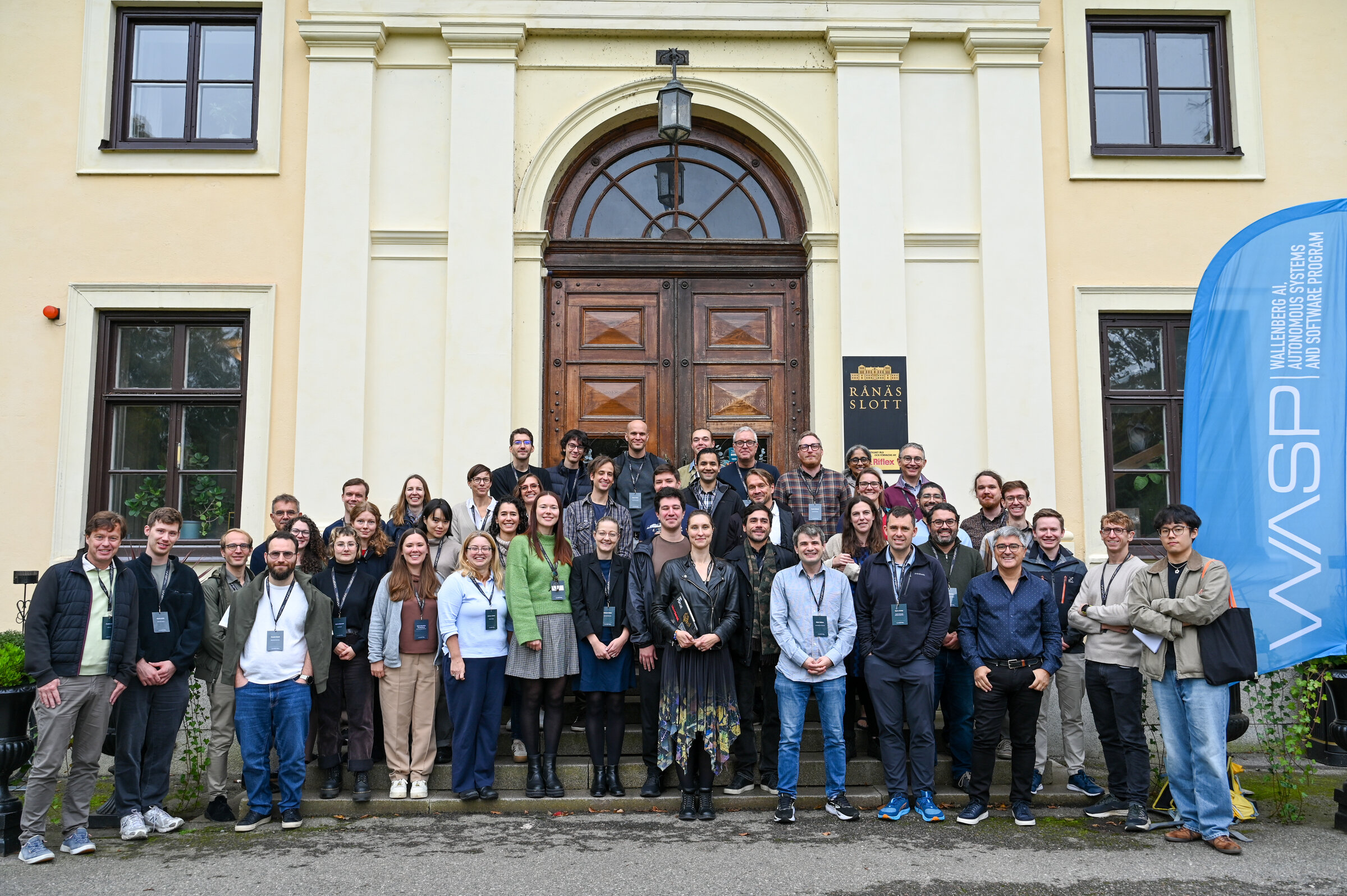
Jan Gerken co-organized the Wallenberg Advanced Scientific Forum – Autumn 2026: Symmetries in Neural Networks together with Axel Flinth, Elisenda Grigsby, Fredrik Kahl, Kathlén Kohn and Fredrik Ohlsson. The highly interactive workshop took place September 29 – October 2, 2026 at Rånäs Castle and brought together experts to study symmetries in data, parameters and training dynamics of neural networks. Elias Nyholm and Longde Huang also participated in the forum.
Lecture for high school students on Från svarta hål till matematikens djupaste mysterier
Public lecture by Daniel Persson for high school students at Vadsbogymnasiet in Mariestad. Slides (in Swedish) are available here.
Launch of the CHAIR theme Mathematical Foundations of AI
The new CHAIR theme Mathematical Foundations of AI has launched, with Daniel Persson and Jan Gerken among its co-organizers. The theme brings together researchers from computer science, mathematics, physics and electrical engineering at Chalmers and the University of Gothenburg to develop the theoretical foundations of AI, through regular seminars, community retreats and international workshops. More information is available on the CHAIR website.
GDL Workshop in Umeå
Miaowen Dong, Longde Huang, Hampus Linander, and Philipp Misof presented their recent work at the third GeUmetric Deep Learning Workshop in Umeå. This conference, co-organized by Jan Gerken, brought together researchers with interests in the mathematics, geometry and physics behind deep learning.
New Preprint on Boosting Data Augmentation with Stochastic Weight Averaging
A new preprint Boosting Data Augmentation with Stochastic Weight Averaging by Longde Huang, Axel Flinth and Jan Gerken is now available on the arXiv. The paper studies stochastic weight averaging (SWA) as a cheap alternative to deep ensembles for making augmented models equivariant. By approximating the training trajectory at the end of training with an Ornstein–Uhlenbeck process, the paper shows that in the infinite-width limit SWA on augmented data yields an equivariance boost beyond what the performance gain from SWA alone would suggest, confirmed by extensive experiments on computer vision and graph classification models with discrete and continuous symmetries.
Invited talk at the Isaac Newton Institute, Cambridge
Daniel Persson gave a talk on Beyond the chatbot - How I use AI in my mathematical research at the workshop New connections between physics and number theory, held at the Isaac Newton Institute for Mathematical Sciences in Cambridge, July 13–17, 2026. Slides are available here.
Wallenberg Proof-of-Concept grant awarded to Jan Gerken and Daniel Persson
Jan Gerken and Daniel Persson have been awarded a Proof-of-Concept grant from the Knut and Alice Wallenberg Foundation for the project AI-Assisted Ultrasound Guidance for Scalable Medical Training. This is a joint project with Carl Hallgren at Sahlgrenska University Hospital and Sebastian Bramberger at Sindrion Technologies. The Proof-of-Concept program bridges the gap between basic academic research and innovation, giving research groups the opportunity to develop early discoveries towards validated methods, products or processes and to prepare them for commercialization.
Poster at ICML 2026
Jan Gerken presented our paper Finite-Width Neural Tangent Kernels from Feynman Diagrams, joint work with Max Guillen and Philipp Misof, as a poster at ICML 2026 in Seoul. The poster is available here.
New Preprint on Equivariance and Augmentation for Bayesian Neural Networks
A new preprint Equivariance and Augmentation for Bayesian Neural Networks by Miaowen Dong, Axel Flinth and Jan Gerken is now available on the arXiv. The paper studies data augmentation for Bayesian neural networks trained with variational inference, deriving conditions under which exact equivariance is reached, bounds on the equivariance error, and three novel symmetrization techniques. One of them, orbit expansion, outperforms the baseline in both equivariance and overall performance.
This is the first paper for our PhD student Miaowen Dong — congratulations, Miaowen!
Master’s students successfully defend their theses
Congratulations to our master’s students, who have all successfully defended their theses:
- Tage Tykesson: Deep Learning Climate Model Emulation with PEAR
- Atharva Khandait: Discrete Geometry for Comparing and Transferring Neural Representations
- Pietro Rosso: Equivariant Inductive Biases for Weather Prediction with PEAR
- Jonatan Larsen and Filip Nyman: SÄLEN and the Art of Metal Binding
Well done to all of them!
Invited talk at Mathematical Foundations of AI Workshop, Chalmers
Daniel Persson gave an invited talk on Geometric Deep Learning - From equivariance to weather predictions at the Mathematical Foundations of AI workshop, held at Chalmers University of Technology (Palmstedtsalen), Gothenburg, June 8–10, 2026. Slides are available here.
New Version of PEAR Paper on the arXiv
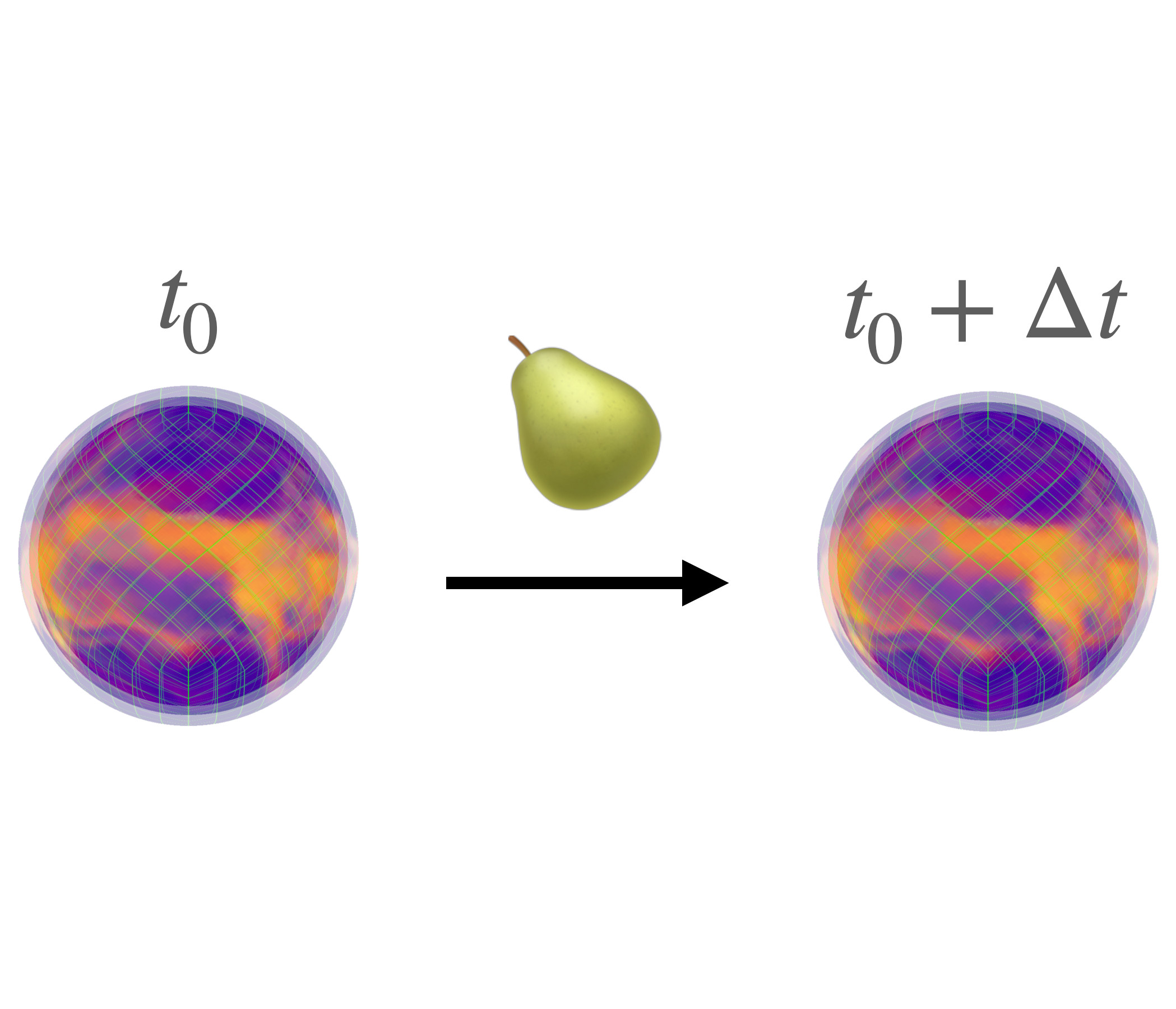
A substantially updated version of our paper PEAR: Equal Area Weather Forecasting on the Sphere by Hampus Linander, Christoffer Petersson, Daniel Persson and Jan Gerken is now available on the arXiv. The new version shows that PEAR outperforms a much wider range of baseline architectures than previously evaluated, demonstrates that PEAR performs well in climate model emulation, and presents new results on the symmetry properties of PEAR.
The new results on symmetry properties and climate modeling are thanks to the work of our master’s students Pietro Rosso and Tage Tykesson. Congratulations to both!
Daniel Persson interviewed in Forskning & Framsteg
Daniel Persson is interviewed in the Swedish popular science magazine Forskning & Framsteg about the recent AI breakthrough in mathematics, where an AI model solved the 80-year-old Erdős unit distance problem. Daniel comments: “It is a very exciting breakthrough! It is remarkable that AI has been able to solve a problem at this level, with such advanced mathematics.”
New Preprint on Comparing Neural Representations via Diffusion Geometry
A new preprint From Layers to Networks: Comparing Neural Representations via Diffusion Geometry is now available on the arXiv. The paper brings tools from diffusion geometry and multi-view learning to the comparison of neural representations, showing that a broad class of representational similarity measures can be reformulated via row-stochastic Markov matrices. This yields multi-scale variants of Centered Kernel Alignment and Distance Correlation and enables network-to-network comparisons, achieving state-of-the-art results on the Representational Similarity (ReSi) benchmark.
First author is our master’s student Atharva Khandait, together with Jan Gerken. Congratulations to Atharva on his first publication!
New Preprint on Neural Point-Forms
When Philipp Misof visited last year’s LOGML Summer School in London, the week-long group project sparked an idea for a new paper using Diffusion Geometry to learn geometric differential-forms from point clouds. This work was done together with Bruno Trentini, Jacob Hume, Vincenzo Antonio Isoldi, Katya Ivshina and Kelly Maggs and is now available as a preprint.
New Preprint on Steerable Neural ODEs on Homogeneous Spaces
Daniel Persson, together with collaborators Emma Andersdotter and Fredrik Ohlsson at Umeå University, have published a new preprint on Steerable Neural ODEs on Homogeneous Spaces. The paper introduces a novel geometric framework for equivariant neural ODEs on homogeneous spaces, using parallel transport to steer feature vectors transforming under local symmetry groups.
New Preprint on Criticality and Saturation in Orthogonal Neural Networks
Max Guillen and Jan Gerken have published a new preprint on Criticality and Saturation in Orthogonal Neural Networks. The paper derives layer-wise recursion relations for the finite-width statistics of networks with orthogonal weight initialization and extends the recently-introduced Feynman diagram framework to this setting, providing a theoretical explanation for the depth-stability of orthogonally-initialized nonlinear networks.
Paper accepted at ICML 2026
Our paper Finite-Width Neural Tangent Kernels from Feynman Diagrams by Max Guillen, Philipp Misof and Jan Gerken has been accepted at ICML 2026! The paper introduces a Feynman diagram framework for computing finite-width corrections to NTK statistics, enabling layer-wise recursive relations for preactivations, NTKs and higher-derivative tensors required to predict training dynamics at leading order.
Invited talk at AI4Physics Workshop, Uppsala University
Daniel Persson gave an invited talk on Geometric Deep Learning - From equivariance to weather predictions at the AI4Physics Workshop at Uppsala University. Slides are available here.